
Running a successful business can be like conducting an orchestra. With so many moving parts and players to manage, it’s easy to play off-key and out of sync. That’s where business process management (BPM) comes in. BPM provides the sheet music that guides your organization’s movements and keeps everyone in tune.
BPM is a systematic approach that helps you streamline and optimize business processes from start to finish. It can involve the implementation and adaptation of software, strategies, procedures, or even roles within the company. By identifying inefficiencies and areas for improvement, a business process management system can eliminate bottlenecks, improve process management, increase operational efficiency, and reduce costs, giving your business the power to outpace the competition. Whether you’re in manufacturing, healthcare, retail, or any other industry, BPM can help you take your business to the next level by enhancing your business processes.
And organizations are implementing business process management software at a remarkable rate:
Gartner has estimated that the global BPM market would grow at a CAGR of 8.2% from 2020 to 2027, reaching USD 16.9 billion by 2027.
It has become increasingly important for companies to incorporate business process management into their daily business operations.
So, in this blog post, we’ll discuss the importance of business process management and how it benefits organizations. Let’s dive in!
Importance of business process management for your organization
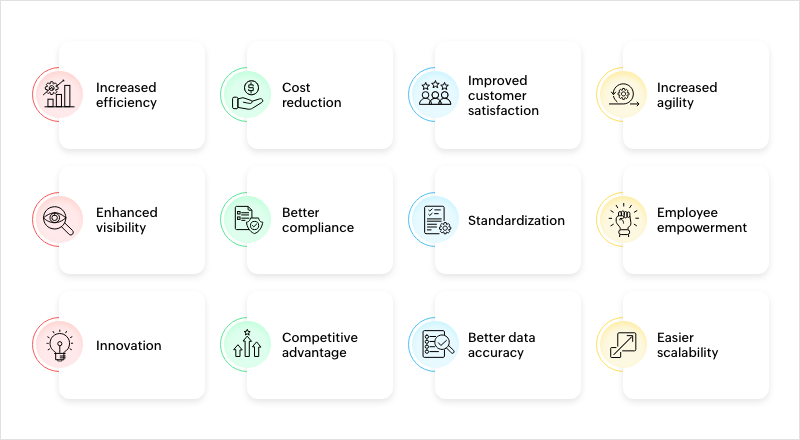
1. Increased efficiency
Business process management helps organizations improve efficiency, reduce waste, and achieve sustainable success. For instance, a retail business can automate and streamline its inventory management system by using sensors to detect inventory levels and update their database in real time. This minimizes the risk of stockouts and overstocks and frees up employees to focus on other important tasks.
2. Cost reduction
In today’s highly competitive business environment, reducing costs without sacrificing quality or productivity is essential. With BPM software, a manufacturing company can optimize its procurement process, allowing it to identify the most efficient suppliers and negotiate better prices by analyzing historical purchasing data.
3. Improved customer satisfaction
Business process management enhances customer satisfaction by helping brands deliver high-quality customer experiences. By enabling companies to deliver products and services quicker and more accurately, BPM can lead to improved efficiency, customer experience, and, potentially, more repeat business.
4. Increased agility
Business process management helps businesses navigate the ever-changing business landscape and stay ahead of the competition. For example, a financial services company can expedite its loan approval process by analyzing loan application data in real time and automating the approval process.
5. Enhanced visibility
By providing organizations with greater process visibility, BPM helps identify bottlenecks and areas for improvement. For instance, a logistics company can track each order’s progress in real time and identify delays or issues in its order tracking process, so it can take corrective action promptly.
6. Better compliance
Ensuring compliance with regulations and internal policies is critical for companies in industries like finance, healthcare, and manufacturing. Business process management can help organizations achieve compliance and avoid hefty fines, legal penalties, and reputational damage.
For example, a retail company can automate its compliance processes with Payment Card Industry Data Security Standards (PCI DSS) using BPM software, monitoring payments in real time and ensuring compliance with regulatory requirements.
7. Standardization
Whether you run a small business or a large enterprise, business process management can help you standardize your processes to achieve your business goals. For instance, a manufacturing company can ensure its products are of consistent quality, regardless of the location where they’re produced.
8. Employee empowerment
Business process management empowers employees with the tools and information they need to be motivated, productive, and innovative. For example, providing customer service representatives with real-time data on customer interactions helps them understand customer needs and respond to questions and complaints more effectively.
9. Innovation
Today, innovation is a key driver of success. By continuously innovating and undergoing business transformation, companies can improve existing processes, fulfill customer needs, and drive revenue growth to remain competitive. For example, a manufacturing company can leverage new technologies to monitor its production process instantly and identify opportunities for optimization.
10. Competitive advantage
Providing companies with real-time data and insights enables them to make informed decisions and quickly adapt to changing market conditions. For instance, a logistics company can leverage business process management to optimize its core business processes and gain a competitive edge by reducing costs, improving delivery times, and enhancing customer experiences. This could involve analyzing and redesigning workflows, implementing technology and automation, and improving supply chain visibility.
11. Better data accuracy
Business process management can significantly improve the accuracy and reliability of business data. When tasks are automated and workflows are standardized, organizations can minimize human error and maintain consistent records. For example, a healthcare provider can use BPM to log patient information across systems automatically, ensuring that every department has access to accurate and up-to-date data, which leads to better diagnosis, treatment, and patient outcomes.
12. Easier scalability
As a business grows, managing increased workloads and onboarding new employees can be challenging. BPM enables smoother scalability by creating structured, repeatable processes. For instance, a growing IT services firm can automate its employee onboarding process—ensuring new hires receive the necessary tools, training, and access without disrupting ongoing operations. This allows the business to scale smoothly while maintaining productivity and consistency.
Overall, BPM is a critical tool for organizations looking to optimize their business operations and achieve their strategic goals.